Showing posts with label ginger. Show all posts

Tuesday, 20 March 2018

Home Remedies for a Sinus Infection

A sinus infection usually occurs due to a virus, but it can also be caused by bacteria or fungi. It is often triggered by a cold that causes swelling and inflammation of the sinuses and leads to a buildup of mucus, thereby blocking the sinuses.
Sinuses are hollow, air-filled sacs behind the cheekbones and forehead that, when filled with fluid, harbor germs giving rise to infection.
Other conditions that can cause a sinus infection include allergies, nasal polyps, a deviated septum, and exposure to pollutants and tissue irritants like over-the-counter nasal sprays, cigarette smoke and cocaine.
Common symptoms of sinus infections include a headache, facial tenderness, pain or pressure, nasal stuffiness, discolored nasal discharge, a sore throat, cough and fever. Some people may experience increased sensitivity or a headache when leaning forward.
To relieve the symptoms of a sinus infection, you can use some easy natural home remedies. Also, consult your doctor for proper diagnosis and treatment.

home remedies for a sinus infection
Here are the top 10 home remedies for a sinus infection.

1. Nasal Irrigation
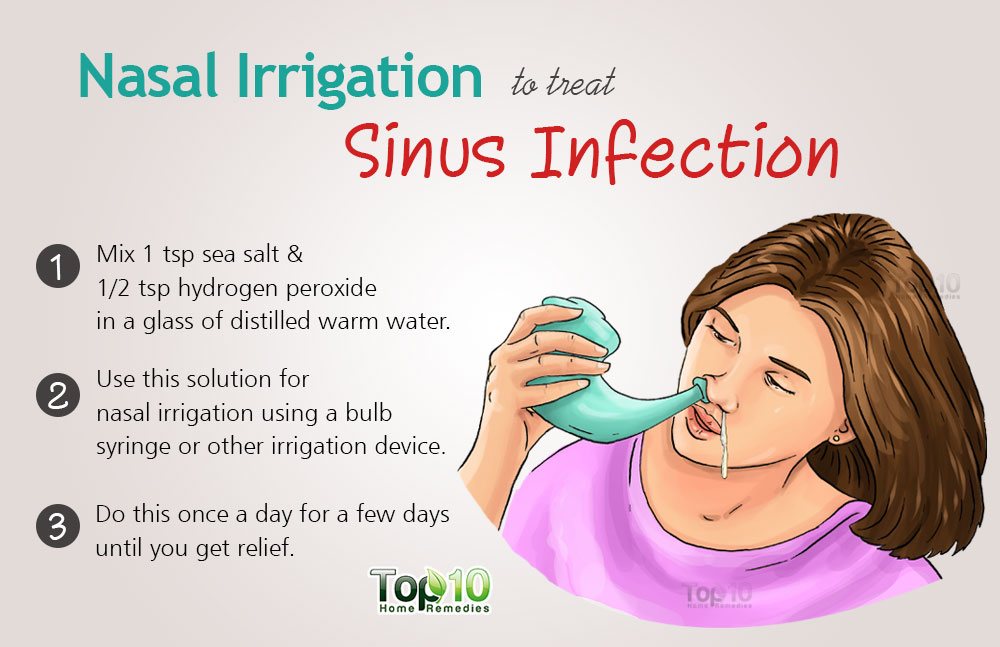
nasal irrigation for sinus infection
Nasal irrigation is highly beneficial for sinus infections as it helps clear out mucus and other debris from your sinuses. Plus, it keeps them moist.
  • Mix one teaspoon of sea salt and one-half teaspoon of hydrogen peroxide in a glass of distilled warm water. Use this solution for nasal irrigation using a bulb syringe or other irrigation device. Do this once a day for a few days until you get relief. Do not use it more often than daily as it may irritate the mucus membranes.
  • Alternatively, mix one-half to one teaspoon of pickling or canning salt and a pinch of baking soda in a cup of lukewarm distilled or previously boiled water. Use this solution for nasal irrigation. You can use it two or three times a day for about a week.

2. Apple Cider Vinegar

Apple cider vinegar has antiviral, antibacterial, antifungal and anti-inflammatory properties that help treat sinus infections. Taking apple cider vinegar at the start of colds, flu or allergies can help prevent a sinus infection from developing.
  1. Add two teaspoons of apple cider vinegar to a cup of warm water.
  2. Mix in one teaspoon of honey.
  3. Drink this solution three times a day for five days.

3. Cayenne Pepper

Cayenne pepper is an effective home remedy to open up and drain the sinuses. Also, it boosts immunity, reduces swelling and inflammation, and improves circulation.
  • Mix one teaspoon of cayenne pepper in a cup of hot water. Drink it two or three times a day.
  • Alternatively, you can eat a mixture of one teaspoon each of cayenne pepper and honey a few times a day.
Use either of these remedies for a few days or until you see improvement.

4. Onion

Onion works as an excellent decongestant to open up your sinuses. Plus, it contains sulfur compounds that fight bacteria and fungi.
  1. Chop an onion into small pieces and put the pieces in a pot of water.
  2. Let it boil for about five minutes, and then inhale the vapors for a few minutes.
  3. Next, strain the liquid and drink it.
  4. Repeat a few a times a day for about a week or until the congestion clears.

5. Garlic

Garlic works as a natural antibiotic to fight sinus infections caused by bacteria and viruses. It is particularly beneficial when the sinus infection is caused by bacteria. Garlic also has antifungal properties.
  • Chop two or three garlic cloves, add them to a pot of boiling water and inhale the steam of this garlic-infused water for a few minutes. Repeat a few times daily until you get relief.
  • You can also eat two to three fresh garlic cloves (preferably crushed) daily. Also include onion, garlic, cayenne pepper and horseradish in your soups and meals to help get rid of excess mucus.

6. Horseradish

Horseradish is another popular remedy for sinus infections as it helps remove mucus from the nasal passages. It also contains high levels of sulfur and works as a natural antibiotic.
  1. Put a pinch of freshly grated horseradish in your mouth.
  2. Hold it in your mouth until its flavor dissipates, and then swallow it.
  3. Repeat a few times a day for about a week or until the infection clears.

7. Ginger


Ginger has antiviral, antibiotic and anti-inflammatory properties that help treat sinus infections. The polyohenols present in ginger help inhibit the secretion of mucus, while maintaining normal nasal ciliary motility. Healthy cilia are important for sinus health as they filter allergens and prevent sinus infections.
  1. Cut a two-inch piece of fresh ginger root into slices.
  2. Boil the slices in one cup of water over low heat for about 10 minutes.
  3. Strain the solution, and mix some lemon juice and honey in it.
  4. Drink this tea a few times a day for about a week or until you get the desired results.

8. Oil of Oregano

This essential oil has antiviral, antibacterial and antifungal properties. Plus, being an anti-inflammatory, it helps reduce inflammation. It also works as a great antioxidant and immune-booster.
  • Put a couple of drops of the oil of oregano in one-half cup of boiling water and inhale the steam to clear the congestion and open up the sinuses. Do this daily until the infection is gone.
  • Alternatively, mix two or three drops of oregano oil in a glass of water. Drink this solution twice daily until the infection clears.
  • Another option is to simply put a drop or two of the oil under your tongue daily for about a week, or until you get positive results.

9. Turmeric


Turmeric has antibiotic, antiviral and anti-inflammatory properties that help treat sinus infections and congestion. It has an active compound called curcumin that helps heal the swelling in the sinus cavity and clear the airways.
  • Mix a pinch of turmeric powder in a glass of warm water. Gargle with it a few times a day for a few days.
  • You can also drink a glass of hot milk mixed with one teaspoon of turmeric powder and a little honey. Drink it daily for about one week or until the infection clears.
  • Another option is to create a turmeric smoothie by blending two pieces of turmeric root (two inches), juice from one lemon, one tablespoon of honey, a pinch of cayenne pepper, one banana and one-half cup of water. Drink this smoothie daily for a few days.

10. Steam

Breathing in steam will help relieve nasal congestion and clear sinuses. Plus, a warm compress will help reduce sinus pressure and headaches.
  • Run a hot shower and breathe in the steam vapors for about five to 10 minutes. Do this daily for a few days until the infection clears.
  • You can also place a wet, warm towel on your face for a few minutes, several times a day for a few days to help relieve sinus pressure.
In addition to these remedies, follow some simple measures like drinking plenty of water to thin the mucus and using a humidifier to keep the nasal passages moist. Plus, adequate rest will facilitate speedy recovery.

Monday, 13 March 2017

Do you suffer from cough and chest infection? Treat it with ginger wraps within hours.

A cough has been a common problem in my family and I used to treat it with just ginger wraps. The procedure consists of heating a spoon of ginger powder in about 2 cups of water. Then you have to soak a cotton towel (the old one, I recommend) in this mixture and apply on your chest as hot as you can bear. Cover it with a sheet of film to avoid soaking your pyjamas and at best jump into bed. Leave it for a couple of hours and you should be relieved from a cough and a cold in general. 
Today I`ve found the article which presents another way of fighting with a chest infection - and those wraps seem to be more advanced method than my old one. Let`s try them if anybody suffers from a cough and leave your comment below that this cure worked for you. 
Aleksandra
Here is the article:
(...)A constant cough can also interrupt your sleep. Coughs are pretty common among young children since they are not able to fight colds and the flu as their immune system is too weak. 
When you have a cough, doctors prescribe cough syrups and medicines, as these are considered as the best ways to treat a cough. However, these pharmaceutical remedies can cause serious problems, such as long-term complications and negative side effects, which is especially worrying for parents of small children.
The most common negative side effects that are caused by taking cough syrups and medicines are migraines, sleeplessness and headaches. This happens as the most common ingredients in almost all cough syrups are codeine and dextromethorphan.
You are probably not aware of these ingredients and the negative side effects and complications they can cause.
You must know that the natural remedies, especially those which contain potent ingredients such as honey, are far more beneficial, safe and effective. The following recipe with honey and ginger wrap will solve a chronic cough almost immediately.

The recipe
Needed ingredients:
• 1 tablespoon of ginger powder or fresh ginger
• Honey
• Flour
• Olive oil
• Gauze
• Adhesive tape
• Napkins
How to prepare the ginger wraps
• First, you need to mix the flour and the raw honey.
• Then, add the olive oil and the ginger. Mix all the ingredients well.
• Put the mixture on the napkins and wrap them up with a gauze.
• Fix the napkin wraps on the back or the chest by using an adhesive tape.
If you are preparing the ginger wrap remedy for your child, let your child hold the wrap on the chest for 3 hours before going to sleep.
The wraps may remain on adults’ backs or chest through the night. You should be aware that these wraps cause sweating.
There are no negative side effects or complications of using the ginger wraps. However, you must be careful when you use them on your children, as children’s skin is more sensitive and delicate.
Real experience
One mother tried to use the ginger wrap recipe on her child. The results were incredible. This mother also modified the recipe a bit. Instead of napkins and gauze, this woman used aluminium foil. She also replaced the olive oil with coconut oil but kept the ginger and the honey.
This mother shared her experience of her Facebook profile. Her child always coughed at night, probably two hours before going to bed. However, the results were incredible when she started using the ginger wraps.
The constant coughing was completely gone and her child was feeling well. The congestion disappeared completely. The child was relieved from the coughs and congestion after only four hours.
Honey and ginger are well known natural remedies that have been used for the treatment of many different health problems.
Source: http://healthfularea.com/ginger-wraps/ 
The original title: Cure a Bad Cough and Remove Mucus in the Lungs in a Single Night with Ginger Wraps

Tuesday, 1 March 2016

7 Must-Try Latin Home Remedies


(Photo : Cameron Spencer/Getty Images )
Sick of taking bad-tasting medicines or using chemically-rich beauty products? You have a choice of using more organic and affordable ingredients, and some of these natural treatments have its roots in Latin culture. They are probably already in your home. Below are a few popular Latin home remedies to try:


1) Vick's VapoRub. Abuela has relied on this eucalyptus-filled treatment for many ailments and minor conditions like achy joints, muscle pain, headaches, skin irritations and chapped lips. Aside from its healing elements, the ointment can also work to lubricate door hinges so that it no longer creeks, according to Step To Health.

2) Manzanilla. Next to Vick's, Abuela also relies on the manzanilla for treating stomach problems like cramps and gas pains. Manzanilla is otherwise known as chamomile, so whether you drink the tea or use the topical oil solution to relieve yourself, both can work wonders. For beauty treatments, manzanilla can help treat irritated skin, acne, psoriasis or eczema, per Live and Feel.

3) Tequila. A shot of tequila is great for parties and celebrations, but did you know that it's also effective against colds? Mix tequila blanco with agave nectar and lime juice to treat the sniffles, per Mental Floss. Tequila can also supposedly aid in weight loss, per She Knows. Tequila contains agavin, a type of sugar that helps control blood glucose levels and cleanses the digestive tracts so that overeating is managed.

4) Raw eggs. Uncooked eggs have been known as an effective hair remedy or facial mask but, in many Latino cultures, it's also regarded as a protection for "evil eye," according to Lucky Mojo. Otherwise known as "Mal de Ojo," many Latins believe that the condition causes injury and misfortune, and the eggs works like an amulet that also heals the person who has been victimized by it. Raw eggs are rubbed on the body for three straight days to ward off the evil eye.

5) Onion and Honey. Treating cough is possible by cooking onion with honey until it becomes a consistent syrup concoction. The properties of both ingredients work as an antitussive, according to the book, "Honey in Traditional and Modern Medicine."

6) Lemon and Warm Water. Feeling constipated? Drinking warm water with squeezed lemon should ease up the condition in no time, according to Mind Body Green.

7) Ginger. Aside from making dishes flavorful, the ginger is also one of nature's most useful and effective medicines. It is very common used for fighting colds, alleviating arthritis and menstrual pain, reducing inflammation and treating burns, per Web MD.


By Rachel Cruz media@latinoshealth.com                                      Jan 06, 2016 

Wednesday, 4 March 2015

10 reasons to replace your morning cuppa with ginger tea!

Bhavyajyoti Chilukoti Feb 16, 2015 at 05:09 pm


Ginger tea is well-known for its powerful medicinal benefits that range from fighting nausea to reducing menstrual pain. A sip of this healthy drink in the morning not only refreshes you but also provides a whole range of antibacterial, antioxidant and anti-inflammatory compounds. Though there are numerous reasons to include ginger in your diet, here are 10 ways ginger tea can work wonders for your health!


Health benefits of ginger tea
#1 Acts as natural aid for migraine and tension headache
Ginger contains anti-inflammatory compounds that play a key role in combating various symptoms of migraine and headache. These compounds inhibit the synthesis of prostaglandins that cause inflammation and pain thereby relieving a headache and its associated symptoms namely nausea and vomiting. So the next time you experience a migraine attack or headache, sip a cup of warm ginger tea.
#2 Treats cough, cold and sore throat
By promoting salivation and mucus secretion, ginger tea provides quick relief from cough symptoms. In addition to preventing airway contraction, ginger has antihistamine property that helps in treating allergies thereby aiding in quick recovery from cough and cold. For effective results, drink this tea twice a day. Here are 5 natural remedies for cough and cold that really work!
#3 Aids in the treatment of kidney infections
Ginger contains a volatile oil that is made of gingerol, which has a strong antibiotic action. Coupled with anti-inflammatory and anti-microbial properties, this spice provides effective results in relieving kidney infections. Drink this tea in the morning and in the evening time along with taking medications as prescribed by your doctor for better results.
#4 Reduces menstrual pain
Gingerols present in ginger inhibits the production of these hormones and provides relief from the painful menstrual cramps. Ginger also reduces pitta in the body which is found to cause cramps during periods, thereby relieving menstrual pain. Consume a cup of ginger tea daily (2 – 3 days before your periods) to get rid of delayed menstruation and menstrual pain. Here are 10 natural remedies to reduce pain during your menstrual periods.
#5 Relieves post nasal drip
As ginger tea contains mostly water, it causes thinning of mucus thereby acting as an effective natural remedy to control postnasal drip. This is mainly due to the presence of anti-inflammatory compounds and anti-bacterial action of ginger. All you need to do to get rid of this condition is to drink this tea at frequent intervals.
#6 Stimulates the digestive system
Ginger is packed with antioxidants and that play a key role in the absorption and assimilation of dietary nutrients thereby aiding in digestion. It also helps break down the proteins in your food and protects the stomach against ulcers by promoting mucus secretion. Hence, if you are suffering from indigestion or acidity drink a cup of ginger tea to attain instant relief. Do you suffer from digestion problem? Try these yoga poses to improve your digestive system.
#7 Prevents various types of cancer
A recent research study has shown that ginger posses the ability to induce programmed cell death (apoptosis) and also suppress the activity of protein molecules responsible for cancer. Although ginger can prevent various types of cancer, it is found to be effective against ovarian cancer. To reap the anti-cancer properties of ginger, make it a habit to drink ginger tea every morning.
#8 Helps to deal with arthritic pain
The anti-inflammatory compounds present in ginger root reduce pain associated with inflammatory conditions like arthritis. Apart from reducing pain and inflammation, drinking a cup of ginger tea relieves muscle pain.
#9 Acts as an appetizer
Are you suffering from a poor appetite? Well, cup of ginger tea when consumed in the morning or mid-afternoon might do the trick. Ginger stimulates the production of digestive juices and in turn, increases your appetite. It acts as an effective home remedy to improve digestive power along with cleansing toxins from the stomach. Here are home remedies to improve your appetite and eat more.
#10 Improves blood circulation
Ginger is increasingly gaining recognition as a herb that promotes heart health. Studies have shown that ginger is capable of preventing formation of clots, improving blood circulation, lowering LDL  cholesterol levels and also prevents formation of a blood clot.
# 11 Moisturises the skin
The presence of potent antioxidants and anti-inflammatory compounds in ginger helps in flushing out the harmful toxins from the body and thus, maintain your skin health. Apart from this, drinking ginger tea hydrates the skin thereby helping in restoring the moisture and thus, aid in natural glow. Read about  5 skincare secrets by dermatologists for radiant skin.
Ginger tea – how to prepare it at home?
  • Take a medium piece of ginger, wash and peel it.
  • Now, grate ginger or chop it into few pieces.
  • Add these ginger pieces to a cup of boiling water and steep it for around 10 to 15 minutes.
  • Allow this mixture to cool a little, strain and drink.
  • You can also add honey, tulsi leaves and lime juice (it’s optional).
Image Source: Getty images
References: 
  1. Habib, S. H. M., Makpol, S., Hamid, N. A. A., Das, S., Ngah, W. Z. W., & Yusof, Y. A. M. (2008). Ginger Extract (Zingiber Officinale) has Anti-Cancer and Anti-Inflammatory Effects on Ethionine-Induced Hepatoma Rats. Clinics (Sao Paulo, Brazil)63(6), 807–813. doi:10.1590/S1807-59322008000600017
  2. Zeng GF, Zhang ZY, Lu L, Xiao DQ, Zong SH, He JM. Protective effects of ginger root extract on Alzheimer disease-induced behavioral dysfunction in rats. Rejuvenation Res. 2013 Apr;16(2):124-33. doi: 10.1089/rej.2012.1389. PubMed PMID:Vutyavanich T, Kraisarin T, Ruangsri R. Ginger for nausea and vomiting
  3. Vutyavanich T, Kraisarin T, Ruangsri R. Ginger for nausea and vomiting inpregnancy: randomized, double-masked, placebo-controlled trial. Obstet Gynecol.2001 Apr;97(4):577-82. PubMed PMID: 11275030.
  4. Srivastava KC, Mustafa T. Ginger (Zingiber officinale) in rheumatism andmusculoskeletal disorders. Med Hypotheses. 1992 Dec;39(4):342-8. PubMed PMID:1494322.

Friday, 19 December 2014

Natural home remedies: Colds and flu

It may be “just a cold,” but it’s nothing to sneeze at. And the flu can make you feel downright drained. Fortunately, fast action on your part—including these simple home remedies for colds and flu—can mitigate the misery

Natural home remedies: colds and flu

Is it a common cold or the flu? If your symptoms are above the neck—congestion, sore throat, sneezing, coughing—you probably have a cold. If you have all those symptoms plus a fever of 38.8˚C (102˚F) or more, headache, muscle aches, extreme fatigue, diarrhea, nausea or vomiting, you’re more likely to have the flu.


What you can do for colds and flu

• For a sore throat remedy  fill a 250 mL glass with warm water, mix in one teaspoon of salt and gargle away. The salt really does soothe the pain.
• Add a squeeze of lemon juice to a glass of warm water for the more traditional sore throat gargle. This creates an acidic environment that’s hostile to bacteria and viruses.
• Chicken soup is a time-honoured remedy that is tried, tested and true.Chicken soup stops certain white blood cells (neutrophils) from congregating and causing inflammation, preventing large amounts of mucus from being produced. The hot soup also thins the mucus. Adding freshly chopped garlic to your soup gives the system a powerful boost. While garlic kills germs outright, it also appears to stimulate the release of natural killer cells, which are part of the immune system’s arsenal of germ-fighters. Spike your soup with red (chili) pepper flakes to increase the broth’s decongestant power.
• Drink as much water as you can—eight or more 250 mL glasses—to keep mucous membranes moist and to help relieve dry eyes and other common flu symptoms. Fluids also help thin mucus so that it’s easier to expel.
• To help keep mucus loose, stay in a moist, warm, well-ventilated room. To keep the air in your bedroom moist, place bowls of water near the air ducts or run a humidifier.
• Cut short your cold with a blow-dryer. As outlandish as it sounds, inhaling heated air may help kill a virus working its way up your nose. Set your hair dryer on warm (not hot), hold it at least 45 cm (18 in) from your face, and breathe in the air through your nose for as long as you can—at least two or three minutes—preferably 20 minutes.
• Wear wet socks to bed. Believe it or not, this soggy strategy can help ease a fever and clear congestion by drawing blood to the feet, which dramatically increases blood circulation. (Blood stagnates in areas of greatest congestion.) Best method: Warm your feet in hot water. Then soak a thin pair of cotton socks in cold water, wring them out and slip them on just before going to bed. Put a pair of dry wool socks over the wet ones. The wet socks should be warm and dry in the morning, and you should feel markedly better.
• Try soaking your feet in a mustard footbath. In a basin, mix 1 tablespoon of mustard powder in 1 L of hot water. The mustard draws blood to your feet, which helps to relieve congestion.
• Another oldie: try a mustard plaster for chest congestion. Grind up three tablespoons of mustard seeds, add water to make a paste, and then slather it on your chest. The pungent aroma helps to unclog stuffy sinuses, while the heat improves blood circulation and eases congestion. Don’t leave the plaster on for more than 15 minutes, however, or your skin may burn. You may want to smear on a bit of petroleum jelly before you apply the plaster to protect the skin.
• Breathe easy with steam. Pour just-boiled water into a large bowl. Drape a towel over the top of your head to trap the steam, and breathe in through your nose for five to 10 minutes. Don’t lower your face too close to the water or you risk scalding your skin or inhaling vapours that are too hot. To make steam inhalations more effective, add five to 10 drops thyme oil or eucalyptus oil to the water. Keep your eyes closed as you breathe in the steam, since both essential oils and steam may irritate your eyes. On the go? Dab a few tissues with eucalyptus oil and hold them under your nose whenever you feel congested.

A natural boost for colds and flu

• At the first hint of a cold, suck on a zinc gluconate lozenge every few hours. Don’t take zinc gluconate longer than a week, though, because excessive zinc can actually weaken immunity. Avoid zinc lozenges that contain citric acid or are sweetened with sorbitol or mannitol; these ingredients seem to weaken the mineral’s effectiveness.
• As soon as you notice cold or flu symptoms, start taking 500 mg of vitamin C four to six times a day. If you develop diarrhea, cut down on the dose.
• Take one 250 mg astragalus capsule, twice daily, until you’re better. This ancient Chinese herb stimulates the immune system and seems to be highly effective at fighting colds and flu. To prevent a relapse, take one capsule twice a day for an additional week after your symptoms are gone.
• Goldenseal stimulates the immune system and has germ-fighting compounds thatcan kill viruses. As soon as you begin to feel sick, take 125 mg five times a day for five days.
• At the first sign of the flu, take 20 to 30 drops of elderberry tincture three or four times daily for three days. Elderberry has been used in Europe for centuries to fight viruses.
• Oscillococcinum, commonly called Oscillo, is widely recommended by naturopaths and herbalists to reduce the severity of flu symptoms. Be sure to use it within 12 to 48 hours of the first appearance of your symptoms. It comes in packages of three to six vials. Buy the three-vial pack and take one vial every six hours.
• A dose of garlic—a natural antiseptic—will do a job on those viruses. If you’re feeling very brave, hold a small clove or a half-clove of garlic in your mouth and breathe the fumes into your throat and lungs. If it gets too strong as the clove softens, just chew if up quickly into smaller pieces and swallow with water.
• For a serious congestion-busting blast, buy fresh horseradish or gingerroot, grate it and eat a small amount. To guard against upset stomach, wait until after a meal to try this.
• Drink a cup of ginger tea. Ginger helps block the production of substances that cause bronchial congestion and stuffiness, and it contains compounds call gingerols, which are natural cough suppressants.
• During cold and flu season, take 20 to 30 drops of Echinacea tincture in half-cup of water three times daily.

Adapted from 1,801 Home Remedies, Reader's Digest